Monday, April 18, 2011

Perhentian Islands

After six months apart, each of us on journeys abroad, my brother and I reunited on the small Perhentian Islands off the northeast coast of Malaysia. The pics that follow show bits of the idyllic setting above the water, what I couldn't capture was the awesome coral and reef life (the best I've ever scene) below the surface a short swim offshore. We spent four days soaking it up before heading north for Thailand.  
Adam in front of our bungalow

Jungle exploring

Can't complain about the crowds


Malay school kids on a field trip


Sunset sipping on the rocks, exchanging tales of adventure.


The Streets of Penang


My guesthouse


Rickshaw crew 

Temples are nested throughout the city


Colonial architecture from the days of the British


Foodcourt Penang style   

Fish head curry and a local brew

Permaculture Perak—Potentiality Expanding

Lenggong, Malaysia: Shortly after stepping off the bus in the small mountain town I stood enjoying an Asian pear taking in the scene. A flow of school children dressed in white and Muslim women with pastel head coverings swirled through the bus station, examining me with a hint hesitation until we exchanged smiles—a pleasant indication that I was off the gringo trial. Out of this mix a figure appeared that didn’t fit with the rest, even with deeply tanned skin his European dependence was apparent—must be my host. Ladia, a blue-eyed flurry of dreads, energetically scooted up and extended a warm welcome cloaked in a Czech accent, quickly followed by a question—“how mechanical are you?”

“What do you need?” I replied between my final bites of pear, wondering where this was going.

“Here’s the thing” he said pointing to a landslide cut out of the jungle on a hillside overlooking the town a good distance away. “We live just below there, it’s a long ways away, and yesterday the gasket in my car’s engine broke…can you fix it?”

My answer took little contemplation, “No.” 

“Ok never mind, never mind, we take the motorbike. Come, let’s get some coffee.” 

He ushered me to a Chinese food stall where I sat drinking coffee and exchanging curious looks with the other patrons as Ladia ran around town grabbing a few final supplies. When he returned we made our way to the noble steed tasked with taking us up the hill: a haggard old motor bike with barely enough room for two—this was going to be interesting. We strategically stacked two backpacks, groceries, 10 gallons of gas and ourselves over the thin tires and we were off—right out on to the highway. Popping gears the overburden bike reluctantly gained speed up the gradual hill. Holding on to Ladia’s shoulders my ass hung off the back of the whining bike as traffic sped near our flank. To my western risk assessment the helmet on my head didn’t exactly safeguard me against the potential threats at hand, but worry is counterproductive in such a situation so I directed my attention to the foreign landscape. 

Our transport

After a kilometer on the highway we took a hard right during a gap in traffic, crossing all the lanes at full throttle for momentum to carry us up the steep drive heading off perpendicularly into the jungle. Leaving the flats the bike started the ascent aggressively, bumping and jumping though gravel filled potholes, but the additional strain of the grade got the best of it in time. Despite the addition of Ladia’s leg power pushing us forward, the stressed engine died as we crested the first climb. The farm was still a long ways up so it was clear we needed to rethink our approach. Ladia suggested I walk and he’d take the bags up and return for me shortly—no problem I replied, eager to be off the bike.

 “Just keep following the road up…” Ladia instructed riding away, before turning the corner out of sight he called back “…and if you see an elephant or tiger, just let it be.”

Welcome to Permaculture Perak! 

The farmhouse and kelong 

Though they are a fairly common sight emerging out of the old growth rainforest that surrounds the farm, the tigers, elephants and I, to my dismay, never crossed paths. I spent about a week on the farm (a tea plantation of yesteryears which the jungle has largely reclaimed) which sits halfway up a steep rise overlooking Lenggong town and the Perak River valley. A rough dirt road which becomes impassible after heavy rains is the only way in and out unless you are willing to bushwhack through the jungle, making it an ideal setting for an experiment in self-reliance. Ladia and his partner Hana, both Czech natives, have spent the past three years on the site seeking just that. Heavily influenced by the documentary series Zeitgeist (which I HIGHLY recommend to anyone unfamiliar) the couple is attempting to establish systems that provide an abundance of the ingredients for well-being in life, for themselves and their guests, without a price tag. While this might sound off the wall I would support you in seeing the movie series to better understand the ideological foundation (which I believe is not without flaws but has great merit) before passing judgment. (Watch all three for free at: http://www.zeitgeistmovie.com/).

Sorghum processing--this grain can be substituted for wheat in most applications. Compared to wheat it needs far less water, is easier to grow, produces greater yields and has less gluten...sweet, eh!  

One of the experiments in aquaculture on the farm. 

By any metric the farm is a long way from attaining this goal, but I have the utmost respect for their courage in seeking to explore and exemplify a radical alternative—radical meaning an alternative that strives to get at the root of the problem without compromise. Ladia and Hana are seekers of the sort that seem all too rare in this world—those unwilling to take others truth as their reality without serious examination, causing them take a fresh look at the world and the full range possibilities at hand to try something truly new. As Einstein defined it “insanity is doing the same thing over and over and expecting different results.” We’ve been living in the comfort of our insanity for entirely too long.

Homemade micro-hydro power generation

The nursery--stacking on another function by growing crawling cucurbits on a ceiling mesh.   

Ladia the jungle elf

The Permaculture Perak Farm is not the alternative it is simply an alternative, offering pieces to the bigger puzzle. Ladia is an expert generalist, DIY enthusiast on subjects ranging from generating energy to growing food, to healing yourself or altering your consciousness. Beyond attempting to create a thriving existence outside of the current monetary system, he is very much trying to explore the outer limits of what is generally considered possible. His approach is functional not flash, driven by a tireless imagination that asks not why but why not do it differently—in this regard he taught me much. During my visit stimulating conversation and debate with the wacky crew on the farm was constant, which greatly expanded my knowledge of the true nature of the world, honing my understanding of the role I’m here to play.

Check out the project: https://sites.google.com/site/permacultureperak/home

My boy Billy--chief of the goats 

Pineapple in progress

My scrap-wood bee box 

Complete with combs

Ladia and Hana

Wednesday, April 13, 2011

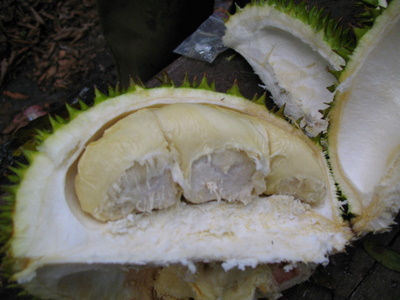
Strange Fruit—The Durian


There is a certain mystique to this odd fruit, you either love it or you hate it. Those that love it get a bit of a crazed look in their eyes at the mention of its name, usually accompanied by a big grin sliding across their face. Maybe it’s the patients the fruit require since you don’t pick durian, they have to offer themselves in ripeness by falling from the tree. And each tree doesn’t produce that many fruit so there is a lot of looking up in anticipation. I’m told that during their season people rise at first light to beat others to newly dropped fruit and disputes between landowners and durian snatchers are common. It’s said that people kill for Durian.

Sabina showing me how its done

The size of an oblong volleyball, Durian’s spine covered outer shell guards five inner chambers each containing three or four large flesh caked seeds. Making up only a small portion of total package it is this fibrous pudding-like seed coating that the consumer is after. The pungent flavor wasn’t instant love for me, maple syrup sweet on the front finishing with an almost garlic taste, it eludes words. 

The goods!

I get the feeling durian might be mildly poisonous but the Malaysians are so mad about the flavor that they look past it. The chief at Embun Pagi casually told me that the day before her daughter at a bit too much which caused her to vomit, as if no big deal, it happens all the time. Supposedly this is avoided by drinking lots of water, I did and it wasn’t an issue. Beer and durian on the other hand is rumored to be a fatal combo, literally. And while it may be urban myth (or countryside in this case) Durian has apparently claimed the lives of some elderly folks who have gotten overzealous with its consumption.

Durian have a potent aroma that is difficult to ignore, to protect those less than enthusiastic about them signs like this are common in hotels and public spaces. 

All this fuss and fervor for this flavor I thought, laughing inwardly after my first taste. But my novice palette was still getting acquainted, there is something strangely seductive about the flavor which grew on me with time. Each morning during my stay at Embun Pagi this newly crazed durian fiend could be found strolling beneath the high canopy in search of freshly fallen fruit….and as if to nurture my new craving, each morning the trees would reward my efforts. I'm hooked.    


Embun Pagi

Permaculture is a design methodology that fuses appropriate technologies and scientific knowledge with ancient wisdom and contextual understanding, for the creation of highly productive arrangements of human settlement patterned after ecological processes. Short for ‘permanent-culture’, the methodology is an ethically driven, holistic approach to crafting integrated, place-based, regenerative systems that create conditions conducive for life. From my perspective permaculture is the most comprehensive and widely applicable theoretical framework for truly addressing the issue of planetary human sustainability—the move now is to explore making the abstract tangible, a process that is inherently unique for every locale. The manifestations of this process vary widely, reflecting the dynamics of resident ecology, unique sets of needs, available resources and the creativity of the practitioners. A growing global web of solution seekers is employing permaculture thinking (often without that label) to radically re-imagine how we inhabit this planet. My travels have taken me to a number of these projects and by lending a hand I’ve had the opportunity to work alongside and learn from those passionate about actualizing an alternative to the dystopia of life as we know it.

Just beyond the fringe of sprawling Kuala Lumpur, Malaysia, in the small town of Batu Arang, lies Embun Pagi—Malay for morning dew. Embun Pagi (EP) is a permaculture project started two years ago by Malaysian Sabina Arokiam after she returned home from completing her Permaculture Design Certificate (PDC) at the Lost Valley Community outside of Eugene, Oregon, USA. Fueled by passion Sabina has tirelessly worked (with admirable success) toward creating her dream of a permaculture education and demonstration center—a hub for propagating knowledge, community collaboration and the exploration of contextual solutions for empowering individuals to create systems that provide food, water, energy and shelter on a local scale. Working with a very limited budget Sabina has resourcefully employed volunteer labor, found objects, donations and a DIY ethic to move the project forward. The site has hosted two PDCs, which has brought together reputable permaculture teachers from abroad with over 60 students from around the world, inoculating them with a problem-solving framework to be infectious spores of change.     
The influence of Embun Pagi is international 

There is a lot stacked on the 1 acre site

 Only two years in the project is very much a work in progress, but in a dynamic world where the only constant is change, sustainability must be thought of as an evolution not a destination--as a verb rather than a noun. This systemic evolution, or development, is cyclical not linear—it’s rhythmic, with the practitioners seeking to orchestrate an ever greater harmony amongst the parts. The greater the harmony, or emergent functionality and efficiency, the greater the ratio of system outputs to inputs known as net yield. Since the potential to increase this harmony is theoretically infinite then so are the potential net yields of the system. In this way a permaculture designer is only limited by their imagination and willingness to seek improvement. Sabina is well on her way to exploring this potentiality in practice, the essential outflow of mental abstractions into useful physical form. I spent two great weeks at EP and relished the opportunity to learn from her wisdom, exchange knowledge and dream big about the future we are co-creating. I look forward to watching her success in years to come.

To learn more about Embun Pagi check out:  http://embunpagi2009.wordpress.com

Sabina in her garden

Aquaculture pond and duck house

An quick-draining herb spiral allows Mediterranean herbs to be grown in the moist clay soils of Malaysia.  

Earthen pizza oven constructed from locally sourced materials 

Bullet box to planter box

We planted hundreds of seeds during my time at EP

Fellow volunteers Asha and Amie gardening in the coolness of the evening  

Carla cheffing up tasty Indian food 

My scrap wood pumpkin trellis  

 Bio-filter--a bacteria driven water cleaning system, constructed from cheap, readily available materials.  

Methane digester--a low cost system for turning manure into cooking fuel 

All precious nutrients stay onsite--humanure is collected and composted to be returned to the gardens.